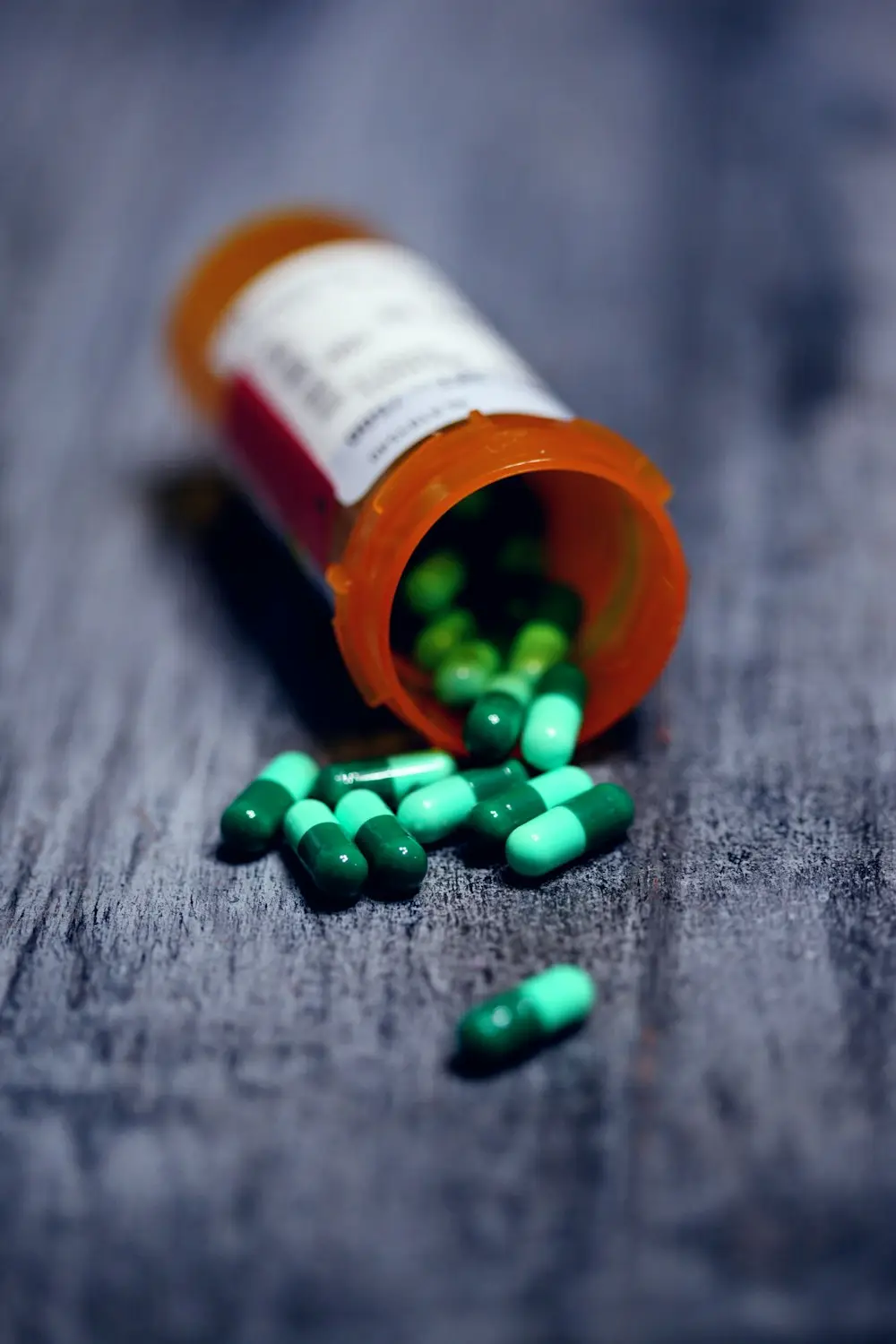
Of all the risks attached to ibogaine, drug interactions are the ones most open to being handled in advance. The pharmacology is documented, the mechanism is specific, and the required action is usually a matter of stopping something for long enough beforehand. That makes this the part of the safety picture where preparation changes the outcome most directly, and also the part most often treated casually.
The core issue is simple to state. Ibogaine is cleared from the body mainly by one liver enzyme. Anything that slows that enzyme raises the blood level reached from a given dose, and the blood level is what drives the cardiac effect. Separately, anything that independently lengthens the QT interval adds to an effect ibogaine is already producing. Those two routes account for most of what matters.
Why interactions matter more here
With most medicines, an interaction that doubles exposure is managed by adjusting the dose. Ibogaine is given as a single large dose with no opportunity to titrate, and the margin between a therapeutic exposure and one that produces marked QT prolongation is not wide. In a carefully screened Dutch series, maximum QT prolongation averaged 95 milliseconds and 7 of 14 patients passed 500 milliseconds [5]. An interaction that pushed exposure higher in that group would not have much room to work with.
There is a second reason specific to this population. Many people seeking ibogaine for opioid dependence are already taking an opioid maintenance medication, and often psychiatric medication alongside it. The overlap between the drugs people are likely to be on and the drugs that interact with ibogaine is substantial, which is why protocols in published studies withdraw a long list of medicines rather than checking for a few.
The enzyme at the centre of it
Ibogaine is converted in the body to noribogaine by removal of a methyl group, and work on human liver microsomes and recombinant enzymes established that this reaction is catalysed predominantly by CYP2D6. The high-affinity CYP2D6 pathway accounted for over 95 percent of intrinsic clearance, only recombinant CYP2D6 showed significant activity, and a liver sample from an apparent poor metaboliser retained only the slow alternative route [1].
That finding has been confirmed in people. In a cohort of 14 patients given a single 10 milligram per kilogram dose with plasma sampling at 14 time points, ibogaine pharmacokinetics were highly variable and tied to CYP2D6 genotype, producing a more than tenfold spread in clearance. The same study found that QT prolongation and ataxia tracked ibogaine concentrations rather than noribogaine concentrations [4].
Two consequences follow. CYP2D6 activity is genetically variable, and the cardiac review of ibogaine notes that the enzyme is functionally absent in roughly 5 to 10 percent of people of European ancestry [3]. And because the cardiac effect tracks the parent compound, slowing its conversion is the specific thing that raises risk, rather than a general change in overall exposure.
CYP2D6 is also one of the busiest drug-metabolising enzymes there is. The same review notes it handles about 30 percent of currently used medicines [3], which means the list of candidate interactions is long and includes many drugs people would not think to mention.
What happens when it is blocked
This has been measured directly. Twenty-one healthy volunteers were pretreated for six days with either placebo or paroxetine, a CYP2D6 inhibitor, then given a single 20 milligram oral dose of ibogaine, far below treatment doses, with sampling over 168 hours [2].
In the placebo group ibogaine was converted rapidly, with noribogaine peaking at a median of 4 hours. In the paroxetine group ibogaine remained detectable for 72 hours with an elimination half-life of 10.2 hours. Exposure to the active moiety, ibogaine plus noribogaine combined, was about twofold higher with paroxetine, and CYP2D6 phenotype correlated strongly with both ibogaine exposure and peak concentration [2].
The authors' own recommendation is the practical takeaway: it may be prudent to genotype, and to at least halve the intended dose in poor metabolisers [2]. Paroxetine is an antidepressant in wide use, and it is far from the only CYP2D6 inhibitor. Several other antidepressants, some antipsychotics, certain antiarrhythmics and a number of common medicines inhibit the same enzyme to varying degrees.
If something here speaks to your situation, the next step is a five-minute provider match profile. We read it personally, take your case to vetted providers, and come back with the ones who say yes — or tell you honestly if ibogaine is not the answer.
Find a providerOne nuance in that finding is worth drawing out. Exposure to noribogaine was similar in both groups, and it was exposure to the combined active moiety that doubled [2]. Read alongside the patient data showing that QT prolongation tracks ibogaine rather than noribogaine [4], the implication is that an inhibitor shifts the balance toward the compound carrying the cardiac effect, and keeps it present for longer. The interaction is not merely a larger total exposure; it changes which of the two compounds dominates.
Methadone is a specific problem
The cardiac pharmacology review states that methadone inhibits CYP2D6 and is likely to impair ibogaine metabolism [3]. This creates an unfortunate alignment: the people most likely to seek ibogaine for opioid dependence are often on methadone, and methadone is itself associated with QT prolongation. The result is a drug that slows ibogaine clearance while adding to the same cardiac effect.
Published protocols handle this by substituting a different opioid before dosing. In the St Kitts series opioid-dependent participants were switched to oral morphine on admission, and the Dutch studies did the same before giving ibogaine [5] [4]. That substitution is not a convenience. It removes a CYP2D6 inhibitor and a QT-prolonging drug from the picture and replaces it with a shorter-acting opioid of known potency.
Methadone also complicates the timing. It has a long and variable half-life, so a substitution carried out shortly before dosing may leave meaningful amounts in circulation. The published series admitted patients to inpatient settings and made the switch on admission [5], which allows the change to be made under observation and the withdrawal that follows it to be managed. A substitution arranged by the person themselves in the days before travelling is a different and less controlled procedure.
Other QT-prolonging drugs
The second interaction route needs no enzyme. Ibogaine blocks the hERG potassium channel in heart muscle at concentrations reached in treatment [8], and any other drug acting on cardiac repolarisation adds to that effect. The relevant classes are well known in clinical medicine and include certain antiarrhythmics, several antipsychotics, some antidepressants, a number of antibiotics, particularly macrolides and fluoroquinolones, some antifungals, and certain antiemetics.
The Dutch study's exclusion criteria show how this is managed in practice. Participants taking any QT-prolonging or CYP2D6-affecting medication were excluded outright, as were those with a QT interval already above 450 milliseconds in men or 470 in women [5]. Those are exclusions rather than adjustments, which reflects a judgement that the combination is not manageable by dose reduction.
An important practical point is that stopping a drug does not immediately remove it. Drugs with long half-lives, including some antidepressants and their active metabolites, persist for weeks after the last dose. A washout measured in days may be inadequate for them, which is a question of pharmacokinetics rather than intention.
Opioids and the receptor picture
A persistent claim holds that ibogaine acts as an opioid agonist and can therefore substitute for an opioid. The laboratory evidence runs the other way. Work across three laboratories, including a replication of an earlier study that had reported full agonism, found that ibogaine, noribogaine and the analog 18-MC acted as mu-opioid antagonists in rat thalamic membranes. Ibogaine stimulated G protein binding in none of the receptor-expressing cell lines tested, and noribogaine was at most a weak partial agonist in one [7].
If ibogaine blocks rather than activates the mu receptor, then it does not provide opioid cover, and the interaction concern with opioids is not additive sedation but the possibility of precipitating or failing to prevent withdrawal. That is in vitro work in rodent tissue and cell lines, and the 2019 review emphasises that the mechanism behind ibogaine's clinical effects remains unresolved [9]. It is nonetheless the best available evidence on the receptor question, and it does not support the substitution claim.
What careful protocols withdraw
The clinic protocol used in the Stanford-assessed veteran cohort gives a concrete picture of what a thorough washout looks like. Before treatment, participants stopped CYP2D6 inhibitors, serotonergic drugs, calcium channel blockers, beta blockers, benzodiazepines, stimulants, corticosteroids and all psychiatric medications, and screening included bloodwork and an electrocardiogram. Exclusions covered cardiovascular, liver and kidney history, psychosis and neurological disorder [6].
That list is instructive for what it includes beyond the obvious. Beta blockers and calcium channel blockers affect cardiac conduction. Benzodiazepines were withdrawn despite being commonly used during ibogaine treatment in other settings. Stimulants carry their own cardiac load. The breadth of the list reflects a protocol designed around the assumption that anything acting on the heart or on hepatic metabolism is a potential contributor.
Withdrawing that many medicines is not itself risk-free, which is a point worth stating plainly. Stopping psychiatric medication can destabilise the condition it was treating, and abrupt benzodiazepine cessation carries its own dangers. A washout is a medical procedure requiring supervision, not a matter of ceasing to take tablets before travelling.
Electrolytes and the things that are not drugs
Potassium and magnesium levels affect cardiac repolarisation independently of any medication, and low levels increase arrhythmia risk. The Dutch protocol required potassium within 3.5 to 5.0 millimoles per litre and gave magnesium if the QT interval passed 500 milliseconds [5]. The veteran cohort received intravenous magnesium sulfate before dosing and again afterwards [6].
This matters because several common situations lower these levels without any prescription involved: diuretics, vomiting, diarrhoea, poor nutrition, and heavy alcohol use. Someone arriving for treatment after a period of poor intake or active withdrawal may have abnormal electrolytes, which is one of the reasons bloodwork before dosing is a requirement rather than a formality.
The general lesson across all of these routes is that an interaction review is only as good as the information it is given. A complete list matters, and it includes things people routinely omit: over-the-counter medicines, herbal preparations, supplements, and anything prescribed by a different clinician for an unrelated problem. Grapefruit and some herbal products affect hepatic enzymes. Since the enzyme in question handles around 30 percent of medicines in use [3], the probability that a given person is taking something relevant is not small, and the only way to find out is a full disclosure before rather than after a dose is calculated.
Frequently asked questions
Which single interaction matters most?
Anything inhibiting CYP2D6, because that enzyme performs over 95 percent of ibogaine's clearance [1] and blocking it roughly doubled active exposure in volunteers [2]. Methadone is the most commonly encountered example in this population [3].
Do antidepressants need stopping?
Published protocols stop them. Paroxetine was the inhibitor used to demonstrate the interaction [2], and the veteran cohort's clinic withdrew serotonergic drugs and all psychiatric medication before dosing [6]. Some have long half-lives, so the timing is a medical question.
Can a dose be reduced instead of stopping an interacting drug?
For poor metabolisers the volunteer study's authors suggested at least halving the dose [2]. For QT-prolonging medication, the Dutch study excluded such patients altogether rather than adjusting [5].
Does ibogaine act like an opioid?
The laboratory evidence indicates the opposite. Across three laboratories ibogaine and noribogaine behaved as mu-opioid antagonists rather than agonists [7].
Why is genotyping mentioned?
Because CYP2D6 genotype drove a more than tenfold spread in ibogaine clearance in patients [4], and the volunteer study's authors suggested it may be prudent to genotype before dosing [2].
References
- Obach RS, Pablo J, Mash DC. 1998, Drug Metab Dispos 26(8):764-768. PMID 9698290. europepmc.org/article/MED/9698290
- Glue P, Winter H, Garbe K, Jakobi H, Lyudin A, Lenagh-Glue Z, Hung CT. 2015, J Clin Pharmacol 55(6):680-687. doi:10.1002/jcph.471. PMID 25651476. doi.org/10.1002/jcph.471
- Koenig X, Hilber K. 2015, Molecules 20(2):2208-2228. doi:10.3390/molecules20022208. PMC4382526. mdpi.com/1420-3049/20/2/2208
- Knuijver T, ter Heine R, Schellekens AFA, et al. 2024, J Psychopharmacol 38(5):481-488. doi:10.1177/02698811241237873. PMID 38519421. PMC11102648. europepmc.org/article/PMC/PMC11102648
- Knuijver T, Schellekens A, Belgers M, et al. 2022, Addiction 117(1). doi:10.1111/add.15448. PMC9292417. europepmc.org/article/PMC/PMC9292417
- Cherian KN, Keynan JN, Anker L, et al. 2024, Nat Med 30(2):373-381. doi:10.1038/s41591-023-02705-w. PMID 38182784. PMC10878970. europepmc.org/article/PMC/PMC10878970
- Antonio T, Childers SR, Rothman RB, et al. 2013, PLoS One 8(10):e77262. doi:10.1371/journal.pone.0077262. PMC3818563. journals.plos.org/plosone/article?id=10.1371/journal.pone.0077262
- Koenig X, Kovar M, Boehm S, Sandtner W, Hilber K. 2014, Addict Biol 19(2):237-239. doi:10.1111/j.1369-1600.2012.00447.x. PMID 22458604. PMC4888945. europepmc.org/article/PMC/PMC4888945
- Marton S, Gonzalez B, Rodriguez-Bottero S, et al. 2019, Front Pharmacol 10:193. frontiersin.org/journals/pharmacology/articles/10.3389/fphar.2019.00193/full