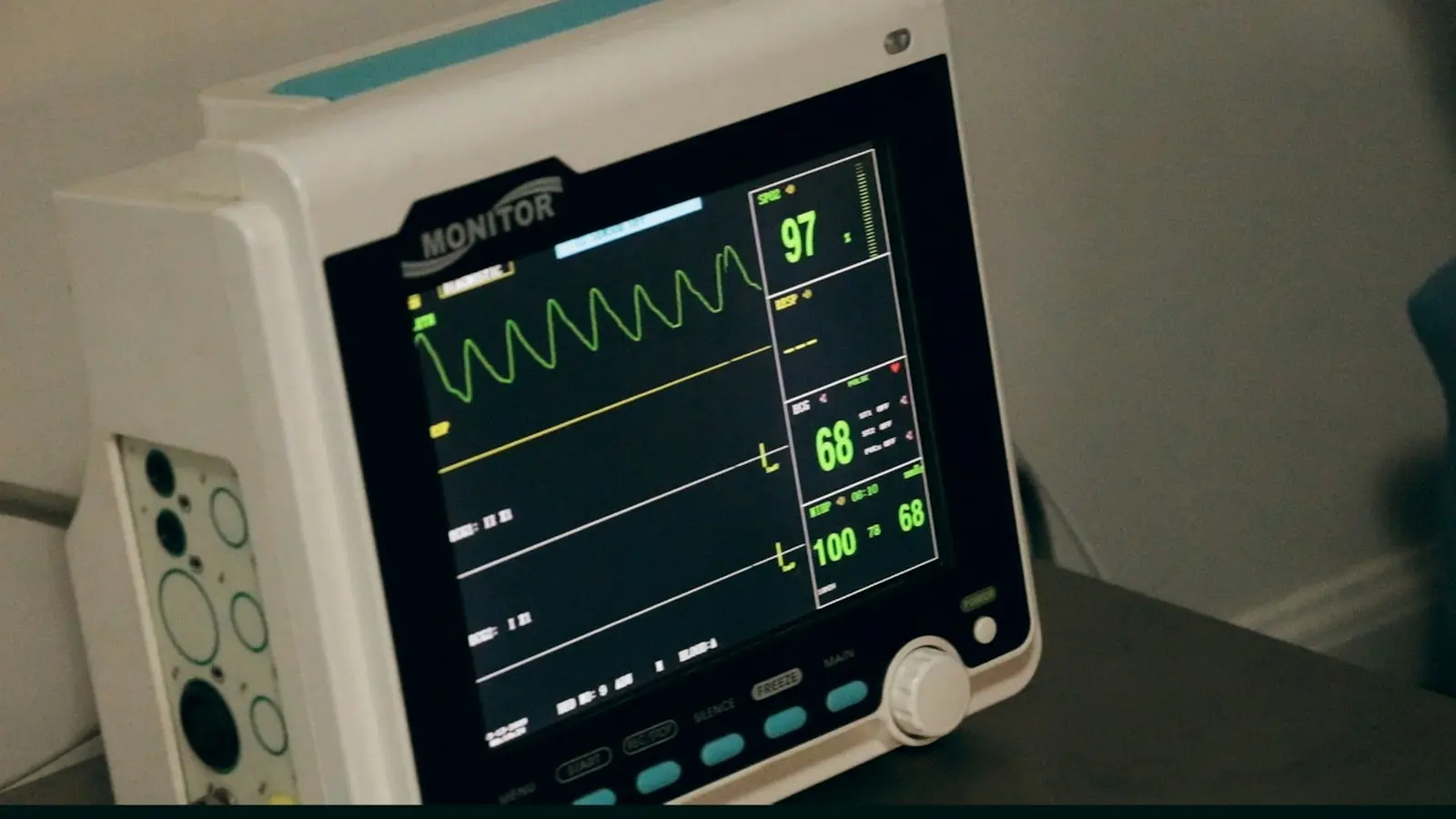
Ibogaine lengthens the electrical pause between heartbeats. In a Dutch hospital study, a single dose lengthened it by an average of 95 milliseconds, and seven of fourteen patients passed the threshold where the risk of a dangerous rhythm climbs [1]. This is the best-measured thing about ibogaine, and it is the reason treatment is organised the way it is.
What the QT interval is
Each heartbeat has an electrical cycle. The muscle is triggered, it contracts, and then it resets before the next beat. On an EKG, the span covering the contraction and the reset is called the QT interval.
The reset phase depends on potassium leaving the heart muscle cells. If that flow is slowed, the reset takes longer and the QT interval lengthens.
A longer interval matters because of what can happen during it. While the heart is still resetting, it is vulnerable to a chaotic rhythm called torsades de pointes, which can stop effective pumping. Because heart rate affects the raw measurement, clinicians use a corrected figure, written QTc.
Above about 500 milliseconds, the risk of that rhythm rises sharply. That threshold is why the number appears in every serious discussion of ibogaine.
What a single dose did in a hospital study
The clearest human data comes from a Dutch university psychiatry department. Fourteen adults with opioid use disorder, all on maintenance treatment and none of whom had reached abstinence with standard care, were switched to morphine and then given a single oral dose of ibogaine at 10 milligrams per kilogram [1]. They were monitored for at least twenty-four hours [1].
The maximum QTc prolongation averaged 95 milliseconds, with a range from 29 to 146 [1]. Seven of the fourteen exceeded 500 milliseconds [1]. In six of the fourteen, the interval was still above 450 milliseconds more than a day after the dose [1].
No patient developed torsades de pointes [1]. That is a reassuring detail about fourteen people treated in a hospital with monitoring and with magnesium available if the interval passed 500 milliseconds [1]. It is not evidence that the arrhythmia does not occur.
The distinction matters for reading any provider's safety record. An absence of events in a monitored group is partly a measure of the monitoring. The same fourteen people, with the same intervals, unsupervised and without magnesium on hand, would not have faced the same odds.
The same study recorded something else that is easy to overlook. All fourteen developed severe transient ataxia and were unable to walk unaided [1]. Whatever else ibogaine is doing, a person under its effects cannot reliably stand, which shapes what supervision has to cover.
Why ibogaine affects the heart
The mechanism here is better understood than the mechanism behind ibogaine's psychiatric effects. The heart's reset depends on a potassium channel known as hERG, and ibogaine blocks it.
In cells carrying the human version of the channel, ibogaine reduced the current flowing through it at concentrations in the range reached during treatment [3]. A review of the cardiac pharmacology puts the concentration needed to halve that current at about 4 micromolar [2].
That figure is close to what has been measured in people. In the Dutch cohort, peak ibogaine concentrations had a median of about 4.8 micromolar [5]. The laboratory concentration that blocks the channel and the concentration a treatment dose produces are the same order of magnitude.
The link between the lengthened interval and harm is not theoretical. QT prolongation after ibogaine has been associated with sudden deaths [6], and a review of case reports places ibogaine-ascribed deaths between about one and a half and seventy-six hours after intake in older cases, and twelve to twenty-four hours in more recent ones [2].
How long the effect lasts
The interval does not return to normal when the drug leaves the blood, and the gap between those two timelines is the practical problem.
More than ninety per cent of a dose is eliminated within twenty-four hours [2]. QT prolongation after ibogaine typically lasts longer than that, and in some reported cases has persisted for more than a week [2].
A person can feel recovered while the measurement that matters is still abnormal. The subjective experience fades well before the electrical one does, which is why monitoring periods are defined by the EKG rather than by how someone says they feel.
The Dutch data shows the same pattern. Six of fourteen were still above 450 milliseconds past the twenty-four hour mark [1], by which point the drug itself had largely gone.
Noribogaine raises it too
The body converts ibogaine into noribogaine, and that compound carries its own cardiac effect.
Noribogaine was tested on its own in twenty-seven patients switched from methadone to morphine, in a randomised, double-blind, placebo-controlled study of three single doses [4]. The QTc rise tracked the concentration, with mean effects of roughly 16, 28 and 42 milliseconds at 60, 120 and 180 milligrams [4].
That is a more rigorous design than most ibogaine research, and it isolates the metabolite. It also means the cardiac exposure continues after the parent compound has gone, since noribogaine has a half-life of twenty-four to thirty hours [4].
If something here speaks to your situation, the next step is a five-minute provider match profile. We read it personally, take your case to vetted providers, and come back with the ones who say yes — or tell you honestly if ibogaine is not the answer.
Find a providerWhy the dose is not the whole story
Two people given the same milligrams per kilogram do not reach the same blood levels, and the spread is wide.
Ibogaine is broken down mainly by a liver enzyme called CYP2D6, and people carry different versions of the gene for it. In the Dutch cohort, clearance varied by more than tenfold across genotype groups [5]. The enzyme is absent or non-functional in roughly five to ten per cent of people of European descent [2].
Someone who clears ibogaine slowly reaches higher concentrations and holds them longer, from a dose calculated the same way as anyone else's.
Other drugs interfere with the same enzyme. Methadone inhibits CYP2D6 and is likely to impair ibogaine metabolism [2], which matters because methadone is common in exactly the population most interested in ibogaine. CYP2D6 also handles about thirty per cent of drugs in current use [2].
The follow-up analysis adds a detail that points at the parent compound. QTc correlated with ibogaine concentration rather than with noribogaine in that cohort [5], as did the ataxia.
What the larger series report
Fourteen patients is a small number. Two larger reports give a wider view, and neither contradicts the picture.
A 191-person inpatient series in which physicians rated opioid withdrawal before and after treatment found withdrawal scores falling sharply [8]. That series ran in a setting with medical staff present, which is the condition under which the cardiac effect is survivable rather than absent.
A New Zealand study followed people for twelve months after ibogaine, and found withdrawal falling acutely and drug-use scores falling across the year [7]. It also recorded one death during treatment [7].
That single line is the most important sentence in the follow-up literature. It sits inside a study usually cited for its positive outcomes, and it belongs in any honest summary of them. One death in a published, monitored cohort is the shape of this risk: uncommon, and real.
The review of case reports describes the pattern across settings. Cardiac events have occurred several days, and in some cases weeks, after intake [2]. Most reported deaths involved either pre-existing cardiac conditions, other drugs taken alongside, or the absence of monitoring, which is the argument for all three precautions rather than against any of them.
What screening and monitoring do
The Dutch protocol shows what careful practice looks like, because its exclusions were published.
People were excluded for a baseline QTc above 450 milliseconds in men or 470 in women, for potassium outside the 3.5 to 5.0 range, for severe liver or kidney dysfunction, and for taking drugs that prolong the QT interval or affect CYP2D6 [1]. During treatment, magnesium was given if the interval passed 500 milliseconds [1].
Each of those has a reason behind it. A baseline already near the threshold leaves no room. Low potassium lengthens the interval by itself. Impaired liver or kidney function changes clearance. A second QT-prolonging drug adds to the same effect.
Screening lowers the risk. It does not remove it. Half the patients in that carefully screened, hospital-monitored cohort still passed 500 milliseconds [1]. Screening selects people whose hearts start from a safer place; it does not stop ibogaine from blocking the channel.
This is the part that gets flattened in marketing. A provider who says screening makes treatment safe is describing something the published data does not support. The honest version is that screening and continuous monitoring move a serious risk down, and that the risk remains after they have done their work. The safety protocols page sets out what the checks involve.
What monitoring is actually for
Continuous cardiac monitoring is often described as a formality. It is better understood as the thing that converts a dangerous interval into a manageable one.
A lengthened QT interval is not itself an emergency. It is a window in which an emergency becomes possible, and the window in the Dutch cohort stayed open for more than a day in six of fourteen people [1]. Monitoring exists so that someone is watching throughout it.
What watching provides is time. Torsades de pointes can resolve on its own or can degenerate, and the difference often comes down to how quickly it is recognised and treated. Magnesium, electrolyte correction and defibrillation all require someone present with the equipment to use them.
This also explains why the monitoring period is longer than most people expect. If the interval is still abnormal at twenty-four hours, as it was for six of fourteen patients [1], then discharge at twenty-four hours ends observation while the risk continues.
Where the research goes next
The cardiac picture is the clearest part of ibogaine research, which is an uncomfortable thing to say about a field studying a treatment.
Several questions remain open. Whether genotyping CYP2D6 before dosing, and adjusting from it, produces a safer exposure than weight-based dosing. Whether magnesium given alongside ibogaine blunts the QT effect, as the Stanford protocol assumed. And how long monitoring should continue, given reports of prolongation lasting beyond a week [2].
Until those are answered, the practical reading is unchanged. The cardiac effect is reliable, measurable and occasionally fatal, and the arrangements around treatment exist because of it.
Frequently asked questions
How much does ibogaine lengthen the QT interval?
In the Dutch hospital study, the maximum prolongation averaged 95 milliseconds, ranging from 29 to 146 across fourteen patients [1]. Seven of the fourteen passed 500 milliseconds [1].
How long does the heart risk last after a dose?
Typically more than twenty-four hours, and in some reported cases more than a week [2]. The drug itself is largely eliminated within a day [2], so the risk outlasts the experience.
Does magnesium make ibogaine safe for the heart?
Magnesium was given in the Dutch study when the interval passed 500 milliseconds [1], and the Stanford protocol combined magnesium with ibogaine from the start. Whether it reduces the cardiac effect has not been established in a controlled comparison.
Why do two people react differently to the same dose?
Mainly because of CYP2D6, the enzyme that breaks ibogaine down. Clearance varied more than tenfold across genotype groups in one cohort [5], and the enzyme is non-functional in about five to ten per cent of people of European descent [2].
References
- Knuijver T, Schellekens A, Belgers M, et al. 2022, Addiction 117(1):118-128. doi:10.1111/add.15448. PMC9292417. doi.org/10.1111/add.15448
- Koenig X, Hilber K. 2015, Molecules 20(2):2208-2228. doi:10.3390/molecules20022208. PMC4382526. doi.org/10.3390/molecules20022208
- Koenig X, Kovar M, Boehm S, Sandtner W, Hilber K. 2014, Addict Biol 19(2):237-239. doi:10.1111/j.1369-1600.2012.00447.x. PMID 22458604. doi.org/10.1111/j.1369-1600.2012.00447.x
- Glue P, Lockhart M, Lam F, et al. 2016, Clin Pharmacol Drug Dev 5(6):460-468. doi:10.1002/cpdd.254. PMID 27870477. doi.org/10.1002/cpdd.254
- Knuijver T, ter Heine R, Schellekens AFA, et al. 2024, J Psychopharmacol 38(5):481-488. doi:10.1177/02698811241237873. PMID 38519421. doi.org/10.1177/02698811241237873
- Marton S, Gonzalez B, Rodriguez-Bottero S, et al. 2019, Front Pharmacol 10:193. frontiersin.org/journals/pharmacology/articles/10.3389/fphar.2019.00193/full
- Noller GE, Frampton CM, Yazar-Klosinski B. 2018, Am J Drug Alcohol Abuse 44(1):37-46. doi:10.1080/00952990.2017.1310218. doi.org/10.1080/00952990.2017.1310218
- Mash DC, Duque L, Page B, Allen-Ferdinand K. 2018, Front Pharmacol 9:529. frontiersin.org/journals/pharmacology/articles/10.3389/fphar.2018.00529/full