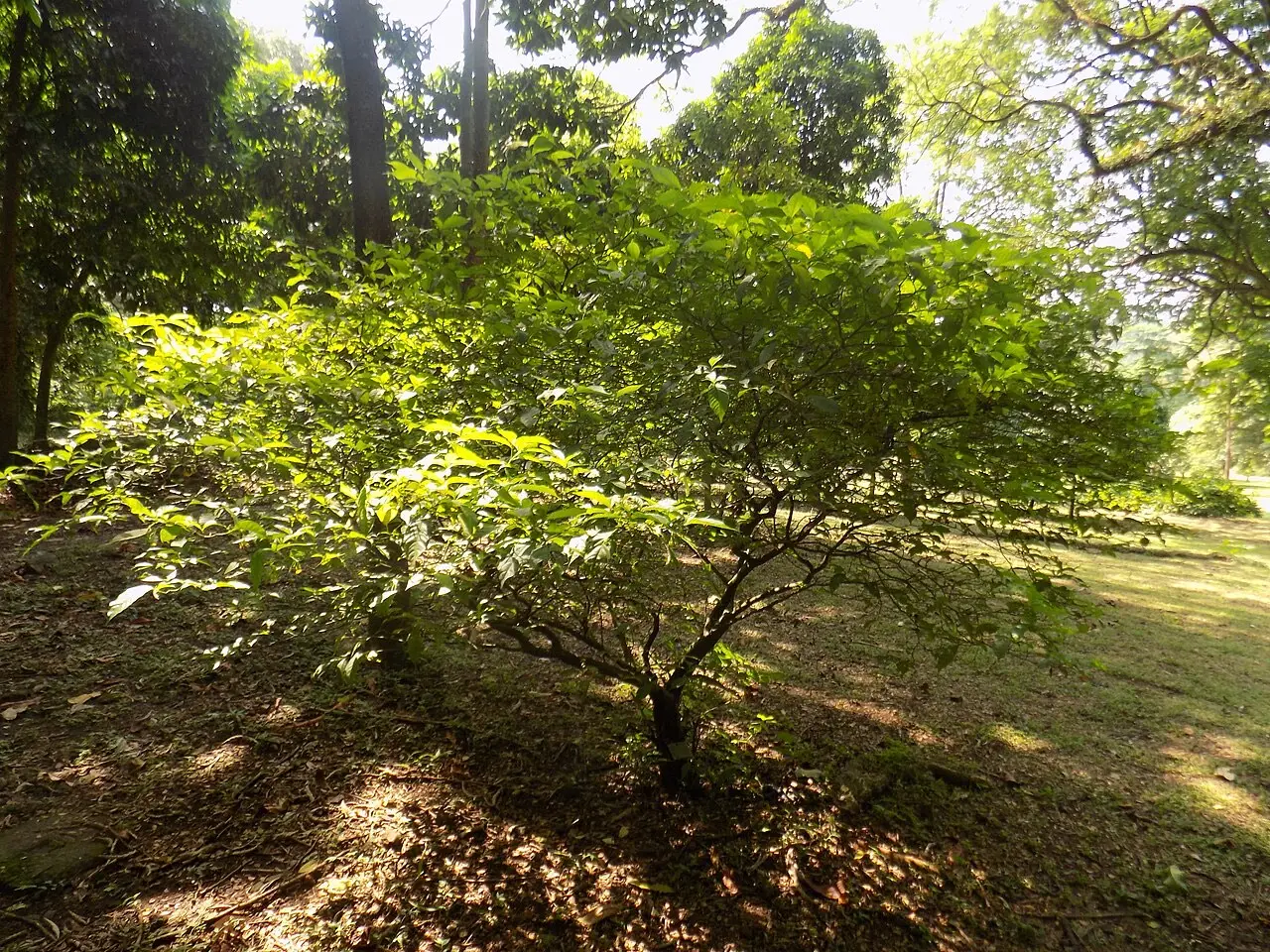
Every account of ibogaine's pharmacology begins somewhere else: with a shrub in Central Africa and a religious practice that has used its root for generations. The relationship between that practice and the clinical research is not simply a matter of historical colour. It bears on where the material comes from, on how the plant is faring, and on a question of obligation that the research literature has itself begun to raise.
What follows keeps to what the ethnographic and review literature records. Bwiti practice is not uniform and is not fully documented in published sources, much of it being held within societies that do not publish, so the honest account is narrower than many secondary descriptions suggest.
The plant and the molecule
The source plant is Tabernanthe iboga, endemic to Central Africa, and the root bark is the main material used. A 2026 scoping review notes that the species is traditionally used in Bwiti ritual practice and that root bark is the principal source of the alkaloid [4].
Ibogaine is one constituent among several in that bark, and not an abundant one: roughly 0.3 percent of root bark by weight [5], with a later synthesis paper giving about 0.3 to 0.4 percent [6]. This is the first substantive point of difference between tradition and clinic. Traditional use involves the bark, a mixture of alkaloids in natural proportion. Clinical research uses purified ibogaine hydrochloride, a single compound at a measured dose. They are not the same preparation and findings about one do not transfer directly to the other.
What Bwiti is
Ethnobotanical fieldwork in Gabon describes Bwiti not as a single religion with a uniform liturgy but as a social and religious institution made up of secret societies, each with its own passage rites and ceremonies [1]. That structure is important for understanding why generalisations are difficult. Practices differ between societies, and the material held within them is not public.
A 2026 peer-reviewed commentary describes ibogaine as central to the Bwiti spiritual tradition of Gabon and Cameroon, and situates iboga alongside ayahuasca, psilocybin and peyote as substances applied within Indigenous medicine traditions over centuries [2]. The relevant framing is that iboga has a long record of use inside a structured practice, under conditions set by that practice.
What that practice is for is not the same as what a clinic is for. Initiation and passage rites are religious and social functions. Treating opioid dependence is a medical one. The overlap between them is real but partial, and describing Bwiti practice as traditional addiction treatment imports a purpose that the ethnographic description does not support.
The secrecy is itself a methodological fact rather than an obstacle to be worked around. A study design that asks informants to list plants and their uses can establish that iboga is named, that it is significant, and that it is widely known. It cannot document the content of rites that participants are not at liberty to describe. Published accounts of what happens inside Bwiti ceremony therefore vary in reliability, and the ones that read as most detailed are not necessarily the ones best sourced.
Sacred wood and a named species
The fieldwork underlying this account used cultural domain analysis with 96 informants in Benin and Gabon, 19 of them Bwiti followers. Iboga was named both as a plant product, the sacred wood, and as a species, eboga [1]. Being named in both registers indicates something that functions simultaneously as a material and as a category of significance.
The authors count Tabernanthe iboga as a cultural keystone species in Gabon, and record that it is among the most sold products in Gabonese herbal markets [1]. A cultural keystone species is one whose role in a culture is such that its loss would damage the culture itself, in the way an ecological keystone species supports an ecosystem. That designation carries directly into the conservation question below.
If something here speaks to your situation, the next step is a five-minute provider match profile. We read it personally, take your case to vetted providers, and come back with the ones who say yes — or tell you honestly if ibogaine is not the answer.
Find a providerHow it reached European science
The compound entered the scientific record in 1901, when Haller and Heckel reported crystalline ibogine to the French Academy of Sciences, obtained from root material they recorded as iboga or aboua, and described clean white orthorhombic crystals melting at 152 degrees Celsius [3]. The paper describes the plant's traditional use in terms of stimulant properties and credits colleagues at Nancy with beginning the work.
Two features of that document are worth noting. The traditional use is acknowledged as the reason the plant was examined at all, since the chemistry was pursued because the material was known to do something. And the framing is of a colonial-era extraction of knowledge: the plant and its use were described, the active compound isolated and named, and the resulting science proceeded in European institutions. A 2026 review observes that ibogaine's scientific history spans more than a century beginning with that isolation [4].
The 1901 paper also records the chain of hands the material passed through. Its footnotes credit Schlagdenhauffen with the chemistry and a physician at the Nancy Faculty of Medicine with the physiology that began the work, and it cites an earlier note by Dybowski and Landrin published in the same volume, whose material the authors suggest may have had a different origin [3]. The uncertainty about provenance in the founding document is a small illustration of a larger pattern: the plant travelled further and faster than accurate information about it.
What the record does not say
Several claims appear routinely in writing about iboga and are not supported by the sources above. The published record does not establish a single traditional dose, because practices vary between societies and the material used is bark rather than a measured quantity of a purified compound. It does not establish that traditional use was directed at substance dependence. And it does not establish a continuous documented history of any specific duration, since the ethnographic literature describes contemporary practice and the historical depth of particular rites is not something a free-listing study measures.
There is a related point about safety that should not be drawn incorrectly. Long traditional use is sometimes presented as evidence that iboga is safe. The cardiac effect of ibogaine was characterised in laboratory and clinical work during the last three decades, and the preparations, doses and settings in traditional practice differ from those in clinical use. A tradition's longevity is not a dataset on arrhythmia risk, and the 2026 scoping review notes that no authorised medicinal products containing ibogaine exist in the European Union [4].
The reciprocity question
This has moved from activism into the peer-reviewed literature. The 2026 commentary states that much contemporary clinical research on ibogaine, including the opioid and traumatic brain injury studies, has been conducted without substantive acknowledgement of or reciprocity toward Bwiti knowledge holders, and calls for co-developed research questions and equitable benefit-sharing [2].
That is a specific charge rather than a general sentiment. The studies named are the ones that constitute the modern evidence base. The authors are not arguing that the research should not have happened; they are arguing that the people whose knowledge identified the plant have not shared in what followed, and that research practice should change.
The commentary is the authors' documented position rather than an established finding, and it is published in a peer-reviewed psychopharmacology journal, which makes it part of the professional conversation rather than external criticism of it. For anyone considering ibogaine, it is also a reminder that the supply chain and the knowledge chain both run back to a specific place and a specific people.
A final absence worth naming is that the ethnographic sources do not describe outcomes. They record that iboga is used, that it is held sacred, and how it is socially organised. They do not report rates of anything, because that is not what ethnography measures. Claims that traditional use demonstrates effectiveness for any condition are therefore drawing a conclusion from a literature that was not designed to support it, in either direction.
Supply and conservation
The arithmetic creates pressure. If ibogaine is around 0.3 percent of root bark [5], then producing a treatment-sized dose from the plant consumes a substantial quantity of root, and harvesting root bark is destructive in a way that taking leaves is not. Combined with the plant's status as a cultural keystone species in Gabon and its presence in herbal markets [1], demand from outside the region bears on both the species and the practice that depends on it.
Chemistry has partly decoupled the two. Most ibogaine in circulation is semi-synthesised from voacangine, which makes up roughly 1 to 1.7 percent of the root bark of the more abundant Voacanga africana, by saponification followed by decarboxylation [5] [6]. A gram-scale seven-step total synthesis from pyridine has since been reported, using low-cost starting materials [6]. A fully synthetic supply would remove the pressure on iboga, and it would also remove any remaining material connection between clinical ibogaine and the plant.
That synthesis work produced an incidental finding that speaks to the chemistry of the molecule itself. The same programme reported the first enantioselective synthesis of the mirror-image form, and found that unnatural (+)-ibogaine lacked ibogaine-like effects on cortical neuron growth [6]. The shape of the molecule, not merely its composition, is what matters, which is a reminder that the plant produces one specific form and that chemistry had to learn to match it.
Earlier routes to ibogaine ran to between nine and fifteen steps with yields under five percent and none of them scalable [6], which is why semi-synthesis from a more abundant plant remained the practical option for so long. The shift to a scalable synthetic route is recent, and whether it displaces plant-derived supply in practice depends on economics rather than chemistry.
Why this matters to a clinical question
Three practical consequences follow. The preparation matters, because total alkaloid extract and purified ibogaine hydrochloride are chemically different and the research was done on the latter. Provenance matters, because the 2026 review identifies absent product standardisation as a structural limitation of the field [4], and an unstandardised preparation means an uncertain dose in a drug whose margin for error is narrow. And the framing matters, because an appeal to tradition is sometimes used to imply a safety record that the ethnographic literature does not contain.
Frequently asked questions
Is iboga the same as ibogaine?
No. Iboga is the plant, Tabernanthe iboga, whose root bark is the traditional material. Ibogaine is one alkaloid in that bark, at roughly 0.3 percent by weight [5].
Is Bwiti a single religion?
Fieldwork describes it as a social and religious institution made up of secret societies, each with its own rites and ceremonies [1], rather than a uniform practice.
Was iboga traditionally used to treat addiction?
The ethnographic sources describe its role in Bwiti rites and as a sacred wood [1] [2], and the 1901 chemistry paper described traditional use in terms of stimulant properties [3]. Use for dependence came later, from outside the region and outside academic medicine, and is not what the ethnographic record describes.
Does most ibogaine come from iboga?
Mostly not. It is usually semi-synthesised from voacangine, obtained from the more abundant Voacanga africana [5], and a gram-scale total synthesis from pyridine has been reported [6].
References
- Quiroz D, van Andel T. 2018, Econ Bot 72(3):251-262. doi:10.1007/s12231-018-9410-x. PMID 30573919. PMC6267723. europepmc.org/article/PMC/PMC6267723
- Magar V, Robbins M, Fernandez (Lobo Blanco) OML, et al. 2026, J Psychopharmacol 40(1):179-188. doi:10.1177/02698811251387104. PMID 41618525. PMC13198619. europepmc.org/article/PMC/PMC13198619
- Haller A, Heckel E. 1901, Comptes rendus hebdomadaires des seances de l'Academie des sciences (Paris) 133:850-853. samorini.it/doc1/alt_aut/ek/haller-heckel-sur-l-ibogine-principe-actif-d-une-plante-du-genre-tabernaemontana-originaire-du-congo.pdf
- Esperanca MP, Gomes NGM, Campos MG. 2026, Molecules 31(3):545. doi:10.3390/molecules31030545. PMID 41683522. PMC12899015. europepmc.org/article/PMC/PMC12899015
- Iyer RN, Favela D, Zhang G, Olson DE. 2021, Nat Prod Rep 38(2):307-329. doi:10.1039/d0np00033g. PMID 32794540. PMC7882011. europepmc.org/article/PMC/PMC7882011
- Iyer RN, Favela D, Domokos A, et al., Olson DE. 2025, Nat Chem 17(3):412-420. doi:10.1038/s41557-024-01714-7. PMID 39915657. PMC11952118. europepmc.org/article/PMC/PMC11952118